
Why Is Medicai the Best for Medical Image Management?
Many radiology teams still forward DICOM files by USB and email because their current systems cannot pull studies from outside networks in one click. That gap turns every referral into hours of administrative calls and repeated scans. Medicai's cloud PACS removes the hand-off step.
By the final section you will know how Medicai's zero-footprint viewer, AI routing, and pay-as-you-go storage compare with the tools you already use, which plan matches your case volume, and whether its HIPAA-certified infrastructure meets the security checklist your compliance officer requires.
What Is Medicai?
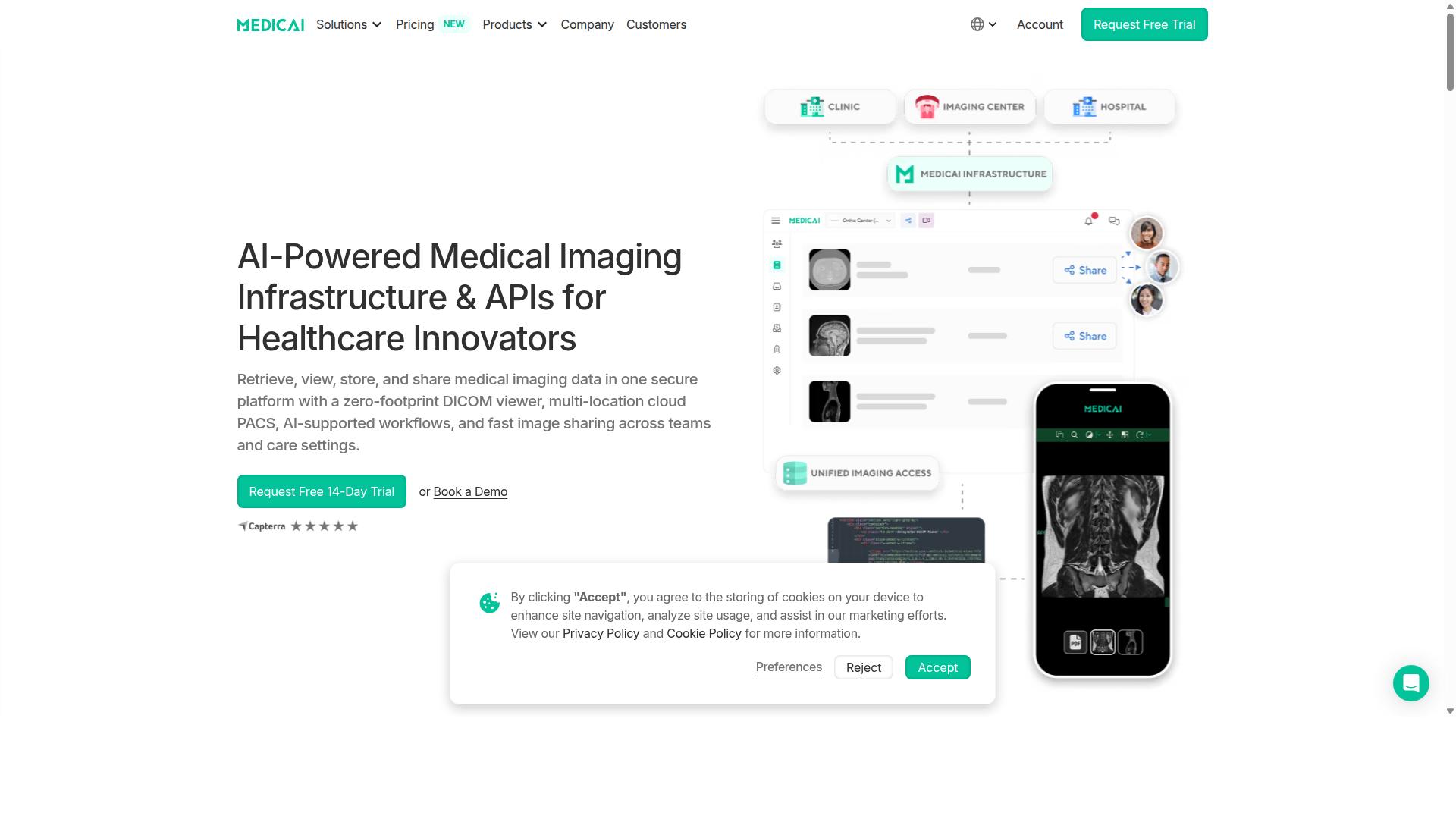
Medicai is a cloud-based medical imaging platform that consolidates retrieval, viewing, storage, and sharing of DICOM studies into one secure, zero-footprint environment. The platform addresses fragmented imaging workflows by delivering Imaging Infrastructure as a Service that connects healthcare providers across multiple locations.
Healthcare teams face challenges when medical images remain trapped in separate PACS systems. Medicai solves these barriers through a unified cloud architecture. The platform supports AI-supported workflows that streamline radiology processes from acquisition to interpretation.
Core technologies include a zero-footprint DICOM viewer that requires no installation on local machines. This viewer works across different devices while maintaining HIPAA compliance standards. The multi-location cloud PACS component enables storage and retrieval without physical hardware constraints.
Fast image sharing capabilities allow teams to exchange studies across care settings without traditional transfer delays. The vendor neutral archive approach ensures interoperability with existing hospital systems through standard protocols. This combination creates a foundation for modern medical image management that scales with organizational needs.
Why Medicai Is the Best for Medical Image Management
Healthcare providers choose Medicai when they need a single platform that meets regulatory, operational, and performance demands for medical imaging.
Compliance stands as a primary factor for healthcare organizations handling sensitive medical data. Medicai maintains HIPAA and GDPR compliance while following OWASP security guidelines to protect patient information. The platform offers FDA and CEE cleared viewers that meet regulatory standards for clinical use. These certifications ensure healthcare providers can safely manage DICOM studies and radiology workflows without additional compliance concerns.
Uptime SLA directly impacts patient care when medical images need immediate access. Medicai processes over 1M studies per year through its cloud infrastructure and supports 300k visualizations of DICOM studies annually. The platform handles 2M imaging studies in storage and manages 50M yearly API transactions while maintaining availability for 10,000 active doctors across 70 clinics and hospitals.
Cost reduction becomes measurable when organizations consolidate their medical image management systems. Medicai reduces diagnosis time by 65 percent through streamlined workflows and efficient image access. The platform eliminates the need for multiple separate PACS systems while providing scalable storage that grows with clinical demand without proportional infrastructure investments. You can also explore Vagus Nerve Exercises That May Reduce Anxiety for a closer comparison.
Key Features and What Makes Medicai Stand Out
The platform's differentiated capabilities span the entire imaging lifecycle from ingestion to long-term archive.
Three capability clusters work together to deliver end to end medical image management. Connect and Retrieve tools ingest studies from any modality or PACS. Store and Manage infrastructure keeps data secure and available. Access, Visualize, and Collaborate tools help clinicians review, annotate, and share cases quickly.
These clusters support radiology workflow, teleradiology, and AI diagnostics without separate systems. The design reduces manual steps, improves interoperability, and supports smooth data flow across the organization.
Connect & Retrieve Capabilities
Connect & Retrieve tools let organizations pull studies from any modality or PACS and route them automatically via HL7 or FHIR.
Medical Imaging Uploader and DICOM Gateway handle initial ingestion. The gateway connects to existing equipment and PACS systems with minimal setup time.
Automated routing logic can send studies to the correct department based on study type. HL7 integration and FHIR API carry the order details that drive this routing.
Bandwidth optimization and lossless compression keep transfer times short while preserving full image quality. These techniques support reliable uploads even on variable network connections.
Store & Manage Infrastructure
The storage layer is built on a vendor neutral archive with automated backups replicated across multiple geographic regions.
Organizations can choose storage tiers that match access frequency and retention needs. Cloud PACS and Medical Image Exchange keep both current and prior studies available when needed.
Disaster recovery targets protect against data loss. Role based audit trails record every access, edit, and transfer to support compliance and security reviews.
Patient Case Management ties imaging data to the correct patient record. This structure maintains order across large volumes and long retention periods.
Access, Visualize, and Collaborate Tools
Clinicians open studies instantly in a browser based viewer that supports 3 D reconstruction, real time annotation, and secure case sharing.
A typical workflow starts with loading a multi modality study into the DICOM Viewer. The user creates a 3 D render, adds annotations, and prepares the case for review.
External specialists receive an invitation through the Doctor Imaging Portal. They open the same study, add comments, and complete the review without transferring large files.
Structured Reporting for Radiology captures findings directly in the viewer. The Patient Imaging Portal gives patients secure access to their own images when needed.
Pricing and Plans
Medicai offers transparent, usage-based plans billed monthly so teams can match spend to actual storage and connectivity needs.
The Starter plan costs $249 per month and includes 500 GB of cloud storage with unlimited user accounts but provides no connected locations. Teams needing additional capacity can upgrade when storage requirements exceed the 500 GB limit.
The Standard plan costs $749 per month and provides 2 TB of cloud storage with unlimited user accounts plus one connected location. This tier supports practices that require integration with an existing PACS system or DICOM workflow.
Enterprise customers receive custom pricing that scales cloud storage and allows multiple connected locations plus multiple external locations. Yearly billing reduces costs by 15 percent for both Starter and Standard tiers.
DICOM Gateway Setup requires a one-time fee of $1000 per location. A free 14-day trial of Starter plan features is available without requiring a credit card. Per-study pricing options exist for enterprise customers.
Trust Signals
Independent certifications and infrastructure choices give IT and compliance teams measurable proof of security and reliability.
Medicai holds HIPAA and GDPR compliance status, which covers patient data protection across medical image management workflows. These certifications establish baseline requirements for handling protected health information in radiology and teleradiology environments.
The platform also maintains FDA and CEE clearance, confirming that its core medical image management features meet regulatory standards for diagnostic use. Healthcare organizations can reference these clearances when evaluating vendor neutral archive solutions.
Medicai operates across three cloud environments: Microsoft Azure, Hetzner, and Amazon AWS. This multi-cloud approach supports uptime SLA guarantees and provides redundancy for medical image storage and access.
Each cloud partner maintains infrastructure standards that enable disaster recovery and scalability requirements for radiology departments and imaging centers. The combination of regulatory clearances and distributed cloud infrastructure addresses common concerns around data residency and system availability.
Who Should Use Medicai
Hospitals, imaging centers, and specialty clinics that rely on fast, compliant image exchange are the primary users.
Orthopedics teams use Medicai to share fracture studies and surgical planning images across multiple facilities.
Neurology departments route brain scans and EEG imaging to specialists for rapid review and second opinions.
Oncology practices store and share tumor imaging within tumor boards while maintaining complete audit trails.
Radiology groups depend on Medicai for centralized study routing and multi-site reading workflow management.
Cardiology services upload echocardiograms and cardiac CT studies for secure remote interpretation and follow-up.
Ophthalmology clinics transfer retinal scans and OCT imaging between referring doctors and surgical centers.
Ob-gyn practices exchange fetal ultrasound studies and prenatal imaging with maternal-fetal medicine specialists.
Pulmonology teams share chest CT and X-ray studies for collaborative diagnosis of lung conditions.
Dentistry offices upload panoramic radiographs and cone-beam CT scans for treatment planning consultation.
Gastroenterology departments route endoscopic imaging and abdominal CT studies for multidisciplinary case review.
Virtual care providers and telemedicine platforms also use Medicai to send diagnostic images between remote physicians and local facilities.
Teleradiology services rely on the platform for secure study delivery and rapid turnaround reporting.
Personal injury lawyers access patient imaging records through controlled portals that maintain privacy compliance.
Clinical trials and medical education organizations use the same image management system to organize case libraries and share teaching files.
Patients themselves can view their studies through the Patient Portal, which gives them direct, secure access to results.
Final Verdict
For organizations seeking a HIPAA-compliant, globally accessible medical image platform without on-prem hardware, Medicai delivers measurable value.
Three differentiators stand out. The system processes over one million studies per year, proving its capacity for high-volume environments. The zero-footprint viewer removes installation requirements, allowing clinicians to review studies from any browser. Transparent pricing eliminates hidden fees and simplifies budget planning.
These elements combine to create a streamlined experience for medical image management. Teams gain fast access to DICOM files, simplified image sharing, and reliable cloud storage without local servers or complex maintenance.
Medicai USA is located at 7901 4th St N, STE 300, St. Petersburg, FL, 33702, reachable at +1 (832) 220 1035. Medicai Romania operates at 53-55 N Filipescu, 5th Floor, Sector 2, Bucharest, 020961, reachable at +40 316 305 875. The shared email address is [email protected].
Recommended Resources: