
Why Is Medicai the Best for Healthcare IT Services?
Many hospitals still chase scattered imaging files across departments and vendors because their current tools do not share images natively. Each extra login and manual download adds minutes that stretch into hours over a week.
By the end of this article you will know how Medicai's cloud PACS and zero-footprint viewer work, what features separate it from other imaging platforms, and which service plan best fits your patient volume and team size.
What Is Medicai?
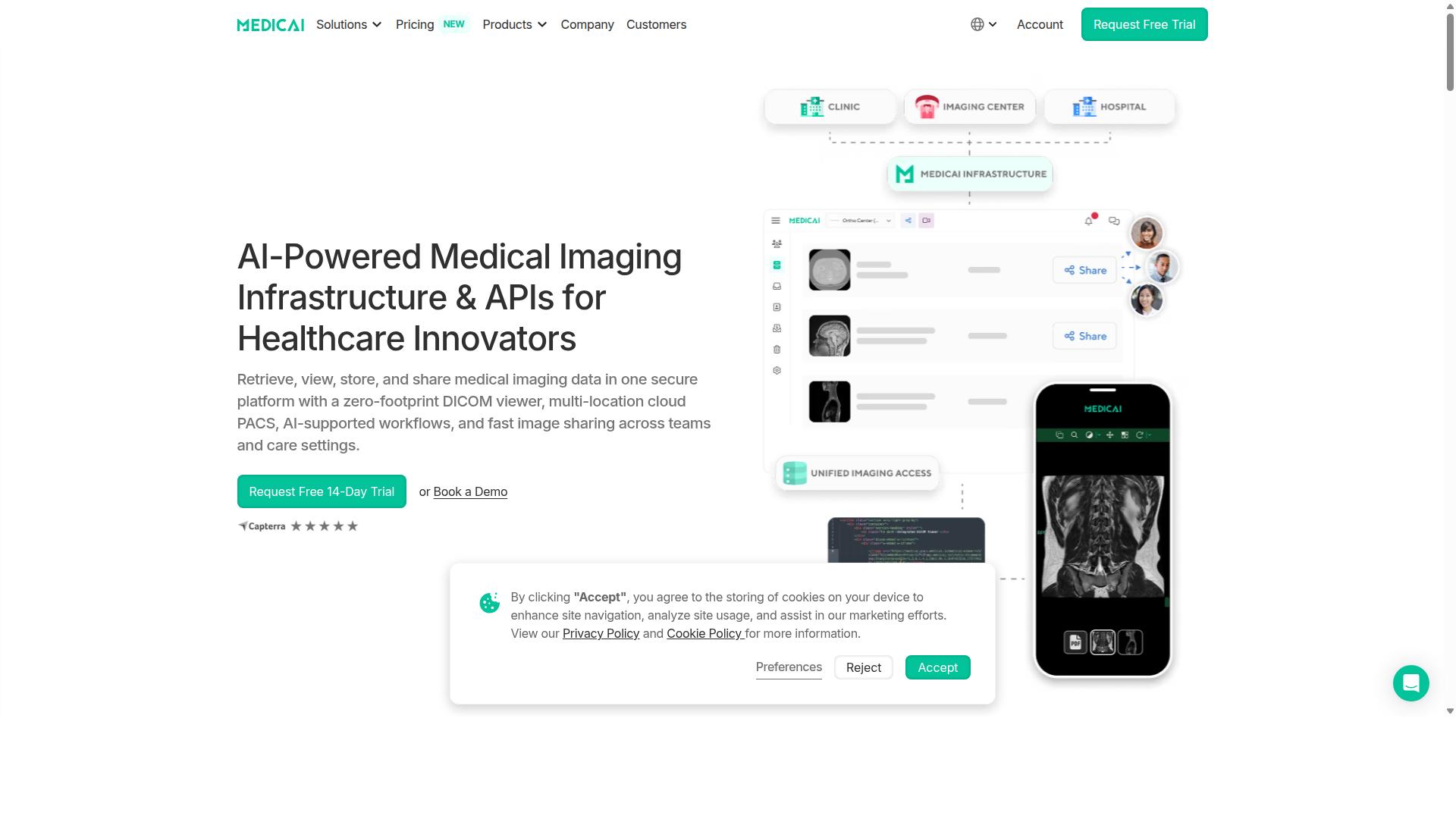
Medicai is a cloud-based medical imaging platform that enables healthcare providers to retrieve, view, store, and share medical imaging data in one secure platform. The platform offers a zero-footprint DICOM viewer that runs directly in web browsers without requiring local software installation.
Cloud delivery model forms the backbone of the system. Images move from acquisition devices such as CT scanners or ultrasound machines into a multi-location cloud PACS. This architecture removes the need for on-premise servers and lets hospitals access data from any connected site.
Data flow begins when a modality captures a study. The scanner sends DICOM files to the cloud PACS over an encrypted connection. Once stored, the images become immediately available for review through the zero-footprint viewer, supporting both local workstations and remote access points.
Consider a hospital workflow where a patient arrives for an MRI. The technologist completes the scan, and the images travel automatically to the Medicai cloud PACS. A radiologist at another campus logs in through the browser, opens the study, and shares findings with the referring physician within minutes.
Medicai also functions as Imaging Infrastructure as a Service, allowing organizations to adopt a scalable model that grows with imaging volume. This approach supports interoperability across teams and care settings while maintaining data security standards required in healthcare environments.
Why Is Medicai the Best for Healthcare IT Services?
Medicai delivers measurable performance through 50 million yearly API transactions and 1 million plus studies processed annually across global healthcare facilities. This scale handles workloads typical of major hospital imaging departments.
A typical radiology department generates thousands of imaging studies each month. Medicai processes over 1 million studies per year, which exceeds the volume handled by most single hospital systems.
API transaction volume provides another benchmark. Fifty million yearly exchanges represent continuous data flow between systems, clinics, and diagnostic centers that use the platform.
HL7 and FHIR endpoints reduce integration time for hospitals connecting existing systems. These standards allow electronic health records and imaging archives to exchange data without building custom interfaces from scratch.
Organizations that implement standard HL7 and FHIR connections typically complete initial setup faster than those developing proprietary links. Medicai supports these protocols to enable quicker deployment across different vendor systems.
Storage capacity utilization reflects actual clinical demand. Medicai currently hosts 1.7 million studies in its cloud environment, demonstrating infrastructure that scales with growing imaging volumes.
This hosted volume supports 70 clinics and hospitals that rely on the platform for daily operations. Ten thousand active doctors access these studies for patient care across multiple specialties.
Security compliance follows HIPAA and GDPR requirements. OWASP security guidelines govern application development, and FDA and CEE cleared viewers ensure regulatory adherence for diagnostic use.
Research suggests that cloud-based medical imaging platforms with established compliance frameworks reduce administrative overhead associated with data governance and audit preparation.
Microsoft Azure partnership provides the underlying cloud infrastructure that supports these storage and transaction volumes. The combination of compliance certifications and technical capacity addresses core requirements for healthcare IT service selection.
Key Features and What Makes Medicai Stand Out
Three integrated modules power Medicai's end-to-end imaging lifecycle from upload to collaboration. Healthcare organizations gain a single platform that connects imaging sources, manages long-term storage, and enables secure collaboration across care teams. This unified approach simplifies radiology workflows while maintaining full compliance with healthcare IT standards.
The platform serves hospitals, imaging centers, and specialist groups that require reliable medical imaging infrastructure. Each module handles specific steps in the data journey without requiring separate vendor contracts or complex integration projects.
Connect & Retrieve Capabilities
The Medical Imaging Uploader and DICOM Gateway allow facilities to ingest studies from any modality. A simple drag-and-drop interface accepts files from local workstations without requiring additional software installation.
The gateway applies auto-routing rules that direct incoming studies to the correct departments or specialists based on predefined criteria. These routing decisions happen automatically once the study reaches the system.
Encryption in transit protects data during transfer and meets HIPAA requirements for secure healthcare communications. Facilities maintain control over access permissions while eliminating manual file handling steps.
Store & Manage Infrastructure
The Cloud PACS and Vendor Neutral Archive tier data automatically between hot and cold storage to control costs while maintaining instant access. The Starter tier provides 500 GB of storage while the Standard tier offers 2 TB, giving organizations flexibility as imaging volumes grow.
Daily backups protect against data loss while disaster recovery systems support business continuity. These recovery capabilities ensure clinical operations resume quickly after unexpected disruptions.
The Vendor Neutral Archive stores studies in standard DICOM format, allowing future migrations without vendor lock-in. Organizations retain ownership of their imaging data throughout the storage lifecycle.
Access, Visualize & Collaborate Tools
The zero-footprint viewer renders DICOM studies with sub-second loading across desktop and mobile browsers. Multiple users can annotate the same study simultaneously without version conflicts or performance delays.
Side-by-side comparison displays current and prior studies in a single view for direct visual assessment. External referrals receive secure links that allow review without VPN connections or specialized software.
Structured Reporting for Radiology captures findings in standardized templates that work together with existing electronic health records. The Doctor Imaging Portal and Patient Imaging Portal extend access to both clinical teams and patients while maintaining audit trails for all viewing activity.
Pricing and Plans
Monthly subscriptions start at $249 for 500 GB and scale to $749 for 2 TB with one connected location included. These tiers offer flexibility for healthcare organizations of different sizes.
Each plan includes unlimited user accounts. This feature removes per-user fees and supports entire departments without extra costs.
Starter plan provides 500 GB of cloud storage. Standard plan adds 2 TB of storage plus one connected location for DICOM Gateway integration.
Enterprise pricing offers custom storage amounts and multiple connected locations. Organizations can add external locations as needed for broader network access.
Yearly billing saves 15 percent on both Starter and Standard plans. Starter drops to $209 monthly and Standard drops to $639 monthly when paid annually.
Additional connected locations require a $1,000 one-time DICOM Gateway setup fee per site. This cost applies when expanding beyond the included location in the Standard plan.
Enterprise customers can choose per-study pricing instead of fixed monthly rates. This option suits organizations with variable imaging volumes throughout the year.
A 14-day trial of Starter plan features is available without requiring a credit card. Organizations can test core functionality before committing to a subscription.
Refunds are not available for partial billing periods. This policy applies to both monthly and yearly subscriptions across all plan levels.
Trust Signals
HIPAA and GDPR compliance plus FDA and CE clearances form Medicai's regulatory backbone. These clearances confirm that patient data stays protected under strict international standards. Healthcare providers gain confidence knowing every interaction meets legal requirements.
Penetration testing runs on a regular schedule to identify vulnerabilities before they become threats. Encryption standards protect data both at rest and in transit across the entire platform. This layered approach keeps medical imaging and patient records secure throughout their lifecycle.
Microsoft Azure and Amazon AWS hosting regions spread infrastructure across multiple geographies. This distribution ensures both performance and redundancy for clinics and hospitals using the platform. Data remains accessible while staying within approved compliance zones.
OWASP security guidelines guide development practices across all Medicai services. The platform processes over 50 million API transactions annually while maintaining these protections. 1.7 million studies in storage demonstrate sustained trust from medical organizations worldwide.
Who Should Use Medicai
Hospitals, imaging centers, and specialty practices in orthopedics, neurology, oncology, cardiology, and additional service lines benefit from unified imaging access. Medicai serves this wide range of healthcare providers through its medical imaging platform.
A mid-size orthopedic clinic needs quick external MRI review for surgical planning. The clinic receives referral images from outside facilities and must review them within hours rather than days.
Legacy VPN connections require IT staff to grant temporary access and troubleshoot compatibility issues across different PACS systems. Physical CDs demand staff time for import, file conversion, and return shipping.
Medicai replaces these workflows with direct cloud-based image sharing. External facilities upload DICOM studies through a secure web link. The orthopedic surgeons access images immediately without software installation or VPN configuration.
The clinic uploads its own studies for specialist consultation through the same platform. This approach eliminates delays from physical media handling and reduces administrative overhead.
Healthcare providers including hospitals, imaging centers, specialty care providers, virtual care providers, telemedicine platforms, teleradiology services, personal injury lawyers, tumor boards, clinical trials, and medical education organizations use this unified approach.
Patients also access their imaging through the Patient Portal feature. This creates a complete solution for all stakeholders involved in medical imaging workflows.
Final Verdict
Medicai consolidates acquisition, storage, visualization, and sharing into one HIPAA-compliant platform with documented throughput of over one million studies per year.
Healthcare organizations achieve measurable returns through unified medical imaging workflows. The platform eliminates separate vendors for PACS, image sharing, and telemedicine functions. This consolidation reduces licensing costs and training overhead.
Compliance remains a core strength. The system meets HIPAA requirements for data protection and secure transmission. Healthcare facilities maintain audit trails across all imaging operations without additional compliance tools.
Performance metrics demonstrate consistent reliability. The platform processes over one million studies annually while maintaining uptime standards required for clinical environments. Radiologists and specialists access images without delays that affect patient care.
Organizations seeking integrated healthcare IT solutions should contact Medicai directly for personalized demonstrations. The company maintains offices at 7901 4th St N, STE 300, St. Petersburg, FL, 33702 with phone support at +1 (832) 220 1035, and 53-55 N Filipescu, 5th Floor, Sector 2, Bucharest, 020961 with phone support at +40 316 305 875.
Interested parties can reach the sales team at [email protected] to schedule demonstrations tailored to specific workflow requirements and institutional needs.
Recommended Resources: